Monday, November 10, 2014

The Remains of Pompeii

Our Italian guide spoke rapid English.  He struggled with the pronunciation of earthquake because he felt impelled to end each word with a vowel.  He called the natural phenomenon a “hurt-a-quake.”  We were touring the remains of Pompeii which was destroyed by a volcanic eruption that covered the entire village in ash. 

There was an old brothel (decommissioned, of course) where the ancient Pompeiians went to pass the time.  Just like today, I bet there wasn’t much to do.  The whorehouse was recognizable by a phallic protrusion hanging above the doorway.  Even back then, subliminal advertising was effectively bringing in customers. 

Inside the building, old paintings showed couples in various positions of copulation.  Perhaps they were instructions for beginners.  I can’t imagine the beds were very comfortable, and I’m sure the repeat customers left with a persistent itch. 

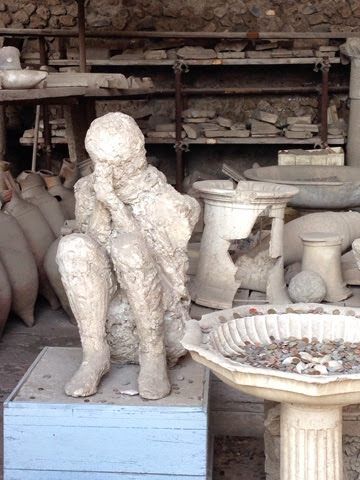
At the end of the tour, there were human plasters on display.  The ash solidified and encased their corpses, frozen in their final postures.  A pregnant woman sprawled out on the ground and breathed through the gaps in her fingers before she suffocated.  Another figure was sitting with his knees near his chest.  His hands were clasped in prayer. 

Aggressive tourists were jockeying for a better position to photograph his remains.  Looking through camera lenses often makes us lose our subjectivity and sometimes our morals.  Although I was slightly disturbed by the disrespect for the dead, I, too, pushed my way toward the front to capture an ironic image of a dead man sitting next to a fountain filled with gold coins.


I bet that man never could have imagined his bodily remains would be such a money-maker on display.  His thoughts were too consumed with the afterlife.  Maybe he was worried about all those trips to the brothel.  How would he be judged by his god? 

Surely he could never conceive of such a consumerist life after death.  But now that man was making more tips than the gypsies begging in the streets.  Tragedy makes for a profitable business eventually.  It’s sad to think some towns are more notable after they’ve been decimated, but repulsive sites are equally attractive for their extreme nature. 

There are two tragedies in Pompeii.  The first obviously being the volcanic eruption.  The second and more relevant is the outrageously priced lunches.  Aaron bought a small salad for four euros, but I wanted something more substantial.  A young, bearded Italian cook caught my eye and immediately started persuading me to buy his food. 

Innocent browsing is impossible here.  I always feel coerced into making decisions to avoid feeling guilty.  The man pointed to lasagna, rigatoni, and gnocchi in long pans behind a glass display.  The mentioning of gnocchi caught my attention, so I inquired about the price.  Its ridiculousness was on par with the rest of the stands nearby, so I had no choice but to pay up. 

Besides, I had already locked eyes with the vendor and wasted his time conversing in broken, simpleton English that consists of pointing to things and grunting, “How much?”  If I backed out at this point, undoubtedly, he would’ve cursed me in his language.  He may have implored me to engage in bestiality with a local farm animal, and I, ignorant to his voodoo, would have thanked him because I didn’t know how to apologize in Italian. 

So I chose the gnocchi and watched him inexpertly spoon the pasta into a bowl.  His tiny utensil necessitated several trips to build a full portion.  The pasta was not near a heat source that I could identify, so I wondered how he was going to warm it up. 

Fortunately, my question was soon answered, but, unfortunately, the solution was a microwave.  So much for authentic Italian cuisine, I thought. After tentatively taking a bite of lukewarm gnocchi, I concluded that Pompeii was struck by a third tragedy.  Not only did its citizens burn to death or suffocate from inhaling a giant cloud of volcanic ash, the present food is overpriced, and the quality is worse than the grub served at my high-school cafeteria.  Is this what the people of Pompeii died for?  Mediocre pasta?         

Sunday, November 9, 2014

We'll Always Have Paris

At the Rome campsite we all sat down and talked late into the night despite the mosquitos that were biting our limbs.  We discussed topics heavier than travel itineraries, but now I can’t remember what we said.  The next day Ryan, Laura, and several others were leaving.  Hands were shaken and bodies were hugged.  Promises were made to visit should we ever find ourselves in a friend’s neck of the woods. 

I tried not to be sentimental, but there was a stretch of silence when I searched for a unique, conclusive statement worth remembering.  I always wanted to deliver a line that stuck in somebody’s mind, like:  “We’ll always have Paris.”  But I couldn’t think of anything cool like that, so I told my friends I was glad to have met them, which is what everyone says.  Maybe I should’ve written something down beforehand.  A speech was excessive, but surely there was something I could’ve said that truly expressed the meaning of our brief encounters. 

After my friends left, the social atmosphere changed.  I mostly talked to Aaron, but there certain topics we didn’t discuss at that point.  Our conversations sometimes sounded like product reviews.  I needed variation, but I could no longer flock to my other comrades who saw the world differently.  Ryan and I could talk about sports, women, and the frustrations of life.  Laura and I have similar personalities, so we didn’t necessarily have to talk about anything.  Her company was peaceful. 


On the Italian island of Capri, Aaron and I hiked up this steep hill that overlooked the bending shore.  We weaved our way through narrow pathways that zigzagged up the mountain.  The streets were lined with walls so that all the houses seemed fortified.  


Giant lemons grew in backyards where trees stood in clumps.  There seemed to be no logic to the geography.  We walked into dead-ends and soon found ourselves confronted by a layer of foliage.  Beyond the bushes was a cliff that dropped off to the sea.  Stairways with steps three feet long intersected a winding road.  Once we reached the summit, slightly out of breath, Aaron asked me, “Do you think Laura would’ve climbed up this hill with us?”

I considered the possibilities, but I wasn’t absolutely certain what Laura would’ve done.  Many of the group members thought we were crazy for wanting to walk that far and exert ourselves so much.  Aaron was a tireless machine, seemingly bent on convincing others of his superior endurance.  I admired his competitive spirit because I possessed one, too, although I tried to bury mine underneath humility. 

Since my days running cross country, I always wanted to go farther and run faster.  I liked being the crazy guy running far away from home that people honked their horns at in greeting.  I imagined them talking to their family later at dinner, saying things like:  You’ll never guess who I saw in the next town over.  I understood Aaron’s emissions of pride when he reported to others how far we hiked.  Our minds may have been wired differently, but at least we could keep up with each other.

We worked our way back through the labyrinth of narrow alleys and sprinted down the hill lest we miss our boat.  The majority of the Contiki group boarded the dinghy and we sailed around the island of Capri.  After the storm clouds blew away, the captain parked us on the blue and inviting water.  The brave, crazy, or drunk ones shed their clothes and jumped into the drink.  I was wearing my glasses, and I can’t see very well without them, so I stayed on the boat and watched my friends shriek and shiver in the shockingly cold water. 

Later that night, I was walking back to the bus with Roisin, a young Scottish woman who was initially shy but has since opened up a great deal.  Her closest friends on the tour left, and their absence saddened her.

“The strangest thing is that we didn’t know each other very well,” Roisin said.  “But we all felt like we could’ve been great friends.”

I tried to console her by telling her that even though we all have only known each other for two weeks, our bonds are strong because we all share such a memorable experience.

“When I was in Ghana for one month, I stayed with a girl from Canada,” I began, “Now I consider her one of my best friends even though we haven’t seen each other in a while.  But if we were to meet up tomorrow, I know we’d hit it off like no time passed at all.”

Despite saying goodbye to friends, there were several reasons to be joyous.  An obvious reason was that we were on vacation in Italy.  But we also added new people to our group. 


In Sorrento, the group dined at this restaurant that featured a stunning backdrop of Mount Vesuvius.  Even more surprising than the view were the reasonable prices.  Aaron and I chose a table closest to the volcano, which was really quite far away.  Dan, a newcomer, pulled up a chair. 

The most noticeable feature of Dan is his Salvador Dali mustache, a waxed work of art twirled upwards at the ends as though his facial hair were smiling.  He’s an extremely cheerful fellow who always has a witty remark parked behind his bristly lips.  He claims that his hilarious mustache is a joke he intends to take as far as he can before it impedes on his daily life.  His quirky spirit is contagious, and I found my mood greatly elevated in his company.

The massive meal of bread, salad, pasta, and pizza was filling and unexpectedly delicious.  It has been my experience that as the view becomes more spectacular the food’s taste wanes.  In these types of restaurants, you pay more to please the eyes and not so much the palate.  We all discussed the benefits of traveling alone while the sun sank in the sky and Mount Vesuvius began to blend into the surrounding darkness. 

Despite our words, I was convinced at that moment I preferred the company of my new friends over the company of my solitary thoughts.  I would always have my thoughts, but my friends would go back to the places they came from and I would return home, richer for having known them.              

Saturday, November 8, 2014

Immersion

When I was travelling alone, I craved company during the silent stretches.  There were a lot of those.  A few friends told me that traveling alone is the best method because you don’t have to compromise with another person who has different tastes or someone who moves rather sluggishly. 

But none of these people ever mentioned the numerous silent stretches spent walking to the train, waiting for the train, sitting on the train.  I had no problem entertaining myself, but every so often I wanted a little verbal back-and-forth from someone I knew.  Conversations with strangers about itineraries, dreams, and wanderlust were even beginning to lag.

When I became part of the Contiki group, I wanted to be free once more.  I wanted my differences to stand out; I didn’t want my personality to be absorbed by the crowd.  When I was out on the road, alone, I naturally adopted the status of an outsider, a label I cling to in order to feel unique.  I wanted to believe my thoughts and opinions were singular and that they had never entered the mind of another person. 

As a teenager, I avoided my girlfriend’s family conventions.  My parents divorced when I was very young, and both sides of my family are very small.  Out of my two uncles and three aunts related by blood, only one aunt has had children of her own.  I only have two cousins.  My mother’s relatives rarely inhabited the same spot because they were spread out across the country until they all moved to Florida.  

I have three brothers, and one of them is my identical twin.  We have always got along easily and shared the same interests, but I have always felt a desire to distinguish myself in order to form my own identity.  Maybe this history explains my reluctance toward immersion into large groups, or perhaps my ego is more swollen than I’m willing to admit. 

Now I am beginning realize how foolish this all sounds.  I am composed of bending bones, working organs, and a functioning brain.  I am the summation of my miniscule cells, and in that regard I am not special.  Yet I still separate myself from everyone else hoping this will help me achieve relevance.  My natural instinct is to do the opposite of what the majority is doing.  I’m not sure what I am trying to accomplish other than attracting a label of unusual or radical behavior.    

Eventually I warmed up to the Contiki group, and a few friendships blossomed.  I toured Paris on my own until Aaron invited me to see the catacombs with him the next day.  Then Ryan and Laura joined our clique, and after they left in Rome I spent more time with Bridget and Ash.  The group didn’t form overnight, but strangely I can recall the moments in which our friendships strengthened. 


When we visited the sand dunes in Biarritz, France, I climbed up the hill and ran down the other side until I reached the frigid sea.  Naturally inquisitive and competitive, Aaron matched my distance, and we wound up far away from the bus with limited time to spare.  We took a short cut through a grassy area because the ascent was not as steep. 


As we neared the summit, we found ourselves barred by a fence that reached up past my stomach.  Since Aaron was taller than me and was wearing shoes, he managed to reach the other side with relative ease.  I wanted to walk barefoot, so I left my shoes on the bus.  The wooden fence was too high to jump over, and there were no perches I could use to propel myself over.  I didn’t have enough time to find an alternative route; I had to jump over the fence and I had to jump now.  But Aaron thought of a better idea. 

I planted my foot onto the smooth, vertical beam of the fence, and my bent knee touched my chest.  Aaron grabbed my hand and pulled me over to his side, and I landed safely.  Since Aaron struck me as being emotionally distant, this gesture surprised me, and I was filled with a sense of euphoria.  Breaking the physical barrier between friends is a surefire way to develop a closer bond.  This is why wrestling can be deemed affectionate. 

Friday, November 7, 2014

The Pickpockets in Rome

An American woman at the train station warned us about the pickpockets.  An older woman approached a man wearing a gray backpack.  She distracted him with conversation while her daughter sneakily unzipped the man’s bag and tried to extract anything valuable. 

When I boarded the train, my tour manager Kat thanked the American woman for the heads-up.  Since I was fascinated by the thieves’ methods, I asked the American to describe their strategy.  After she finished, I remarked that pickpocketing makes for a good story to tell as long as you’re not the one being robbed. 

“Don’t say that,” Kat told me, “Now you might get pickpocketed.  That’s bad karma.”

“I don’t believe in karma,” I said, even though her comment increased my paranoia.  I slipped my hands into my pockets and squeezed my wallet and phone.

“Well, I believe in karma,” Kat said.

“Then it’s a good thing I made that comment and not you.”

I gripped the handle to steady myself on the shaky train.  I tried not to think about the germs forming new colonies on my sweaty palms. 

Aaron, my ever reliable traveling companion, wasn’t disgusted that Italy was filled with pickpockets.  He was annoyed because locals continue to let it happen.  As the innocent tourist was being tricked, many people stood by and watched until a fellow traveler told the man what was happening.  Due to the local’s complacency with thieves in addition to the swarms of persistent gypsies, Aaron dubbed Rome as a “shit-hole with history.”

After a fifteen minute ride, we boarded Rome’s metro, which at the time of this writing has only two lines with plans to build a third.  The city’s subway system is so sparse because each time workers dig a new line they find more ancient ruins.  The metro trains are covered in graffiti, and the subway station is dingy and filthy. 

I eyed all my fellow passengers with distrust.  Each time the train opened its doors, I turned my back away from the exit to prevent anyone from snatching my bag.  Since the foot-traffic funnels and then jams when the crowd disembarks, this is a ripe opportunity to swipe a wallet out of a loose pocket.  I stepped onto the platform in possession of all my belongings and headed into the city.    

On the first day in Rome, Aaron and I visited the Roman Forum, which housed the politicians during the Roman Empire.  At first I thought this would not interest me.  They are merely piles of ancient rocks.  But as I began to read some of the descriptions, I realized these were the oldest crumbled structures I’ve ever seen. Some of the ruins are nearly two thousand years old.  As we searched for the toilets on the premises, I was kicking small stones on the dusty path. 

“We’re walking on the same ground that people like Julius Caesar walked on,” Aaron said. 

“I wonder why people get a kick out of that,” I said.  “Do they think they’ll inherit certain powers by touching the same ground that Julius Caesar touched?”

I overheard a woman gasping with amazement as she took a few photos. 

“Not everyone gets a chance to see this,” she said to her companion. 

Later, I told Laura about this comment, and she assured me that anyone can see the ruins if they save up the money.  The flight to Rome may be pricey, but the entry fee to see the Roman Forum and the Coliseum is only twelve euros.  If you really want to see the ruins, affording this vacation is only a matter of a disciplined work ethic and modest spending. 

To be honest, my aunt paid for half of this vacation.  After working in Europe for a few months when I was a young child, she promised me this present if I graduated college.  While earning my degree, I saved the rest of the money by bussing tables for three years at a wage of six dollars an hour plus a share of the waiters’ tips, which averaged to be roughly $75 per day.  Despite my good fortune and supportive relatives, I still had to work to see Rome. 

“I cleaned toilets and changed bed-sheets,” Laura said, “And I managed to afford this trip.” 

Certainly there are others out there who make a lot more than me or many of my friends on this trip.  Their issue is time, not money.  Although seeing the ruins is not an accomplishment comparable to sailing around the world or summiting a dangerous mountain, the site is worth a visit.  The ruins are scattered throughout a large field, and you can peruse them freely.  There’s nobody selling souvenirs, and nobody in a suit who follows you around and reminds you not to touch anything. 


There are crypts and headless statues situated around humble gardens.  My favorite structures were the cracked columns that stood alone and the arches with Latin words inscribed upon their surface.  The arches were broken, and words were cut in half.  I wondered what happened to the missing piece and what the full sentence read.  I suppose that’s what historians and archeologists do:  they find incomplete clues from long-ago eras and try to piece the fragments together to create a fuller vision of the past. 


When I visited the Coliseum the next day, I tried to imagine what the show would’ve been like during the Roman Empire.  It’s safe to say we don’t have entertainment like the Romans did.  Not even American football or MMA fighting can compare to the spectacles housed in one of the world’s most impressive venues.  Both these sports offer bloodthirsty fans to witness violence from a safe distance, but the severity of these games is much milder. 

Usually the gladiators were slaves or prisoners of war who fought to the death.  The stadium often housed dangerous animals such as bears, lions, tigers, wolves, cheetahs, and ostriches.  The animals would either kill each other, or they would rip apart unarmed humans as the crowd watched from their seats.  Perhaps the gruesome exhibition of such lawlessness was useful in suppressing criminal desires.  Or maybe the Romans had a deranged taste in entertainment.

It is believed that gladiatorial games were meant to placate the public and to benefit the emperor’s reputation as a generous fellow.  Many poor folks would attend the games because they were given free food.  Despite the generosity of the wealthy, the lower-class citizens had to sit in the nosebleed sections.  The politicians and religious figures had better views.  The gladiators were stationed in the eastern and western wings like modern baseball players sitting in their dugouts. 


Seeing the ruins was morphine for the imagination in my attempts to mentally recreate the past.  While I walked around Rome day-dreaming, I wondered what the Romans were doing now.  Where are they working?  Where are the modern office buildings——the ones that are functional and not falling apart?  There was plenty of traffic in Rome, but I had no idea where everyone was going. 

What I knew of Italy before this trip was derived from my European history textbook and a few films like Fellini’s and The Great Beauty, winner of the Oscar for Best Foreign Language Film in 2013.  Because the foreign films were so groundbreaking and beautifully shot, I pictured Italy as a majestic place.  Really, I viewed all of Europe as this utopian hub of intellectual enlightenment. 

Yet certain European countries like Italy did not live up to the preconceived notions I pieced together in my mind.  I spent two days in Rome suspicious of strangers and constantly clutching my pockets.  Several of my friends had phones and wallets plucked out of their purses.  Our group bought I <3 Roma T-shirts for a party at the campsite, but I refused to buy one because I knew I would never wear it again.  Besides, I had only been here two days.  How could I honestly say I loved a city I barely knew?  I was smitten with the old Rome, but the new one rubbed me the wrong way.     

Aside from the food, fashion, and films, perhaps Italy is living off of past glories——the ancient ruins found buried under the dust.  During a salacious party, the old Italian bachelor in The Great Beauty says that Rome has the best trains in the world.  He joins a line of people latched onto each other as they dance to the music in a circle. 

Many years ago, the old man wrote a successful novel, and ever since he has produced nothing.  He survives off the royalties from his book, so he does not have to work.  Instead, he parties endlessly.  He makes plans to change his life and to produce something meaningful again, but he doesn’t.  He realizes his best work is behind him.  Rome has the best trains, he says, because they never go anywhere.  They always end right where they started.    
Thursday, November 6, 2014

The Pope's Pad

A visit to the Vatican costs about forty US dollars.  Although I am not religious and know little about the church, I did not hesitate to pay for this excursion.  Mostly I was curious to see the Sistine Chapel, but to be honest there isn’t much else to do in the Vatican City except buy overpriced gelato and go pope-watching.  The best perk of traveling with a tour group is evidenced when one visits overcrowded attractions such as the Apostolic Palace.  Since I booked with a large group, I got to skip the massive line that spanned half of the tiniest country in the world.
 

The museum that leads up to the Sistine Chapel is immaculately decorated.  The antechambers certainly are not a study of humility but instead an experiment of unlimited wealth with limited wall space.  The walls are covered with ornamental rugs that depict scenes of Jesus’s highlights.  One picture shows him nonchalantly emerging from his rebirth.

“I wasn’t dead, you guys,” Laura imagined the quilted-Jesus saying, “I’ve just had a really long shower.”

Another rug showed him seated at a dinner table with two men who were sharing a bowl of bread.  Jesus raised two fingers in the air. 

“He’s signaling to the waiter,” I said.  “He’s ready for the bill.”

Aside from the religious carpets, the ceiling was covered in various paintings that were positioned every which way, but mostly upside-down from my vantage point.  As far as I was concerned, this was a one-way corridor, so this directional placement made little sense to me.  I shuffled along with the crowd, and I couldn’t stop to scrutinize the details lest I risk being trampled. 

The hallway seemed endless, and I grew tired of looking at paintings inconveniently positioned on the ceiling.  There was way too much to look at, and no time to appreciate the details. I wonder now what is the point of having so much artwork that people will barely see.  One might as well hang watercolors on the side of the four-lane highway.

When we reached the Sistine Chapel, the same overindulgent décor was applied.  The room was cool despite the colossal human zoo forming.  The lights were dim so as not to damage the paintings.  Immediately, I searched for Adam’s and God’s fingers that fail to touch because that was the only image I recognized.  I stared at that for a while to further imprint those two figures in my mind. 

My neck grew cramped scanning the ceiling for ten minutes.  Italian security guards intermittently warned us not to take photos or videos but inevitably some stuck their lens above the crowd to snap a few contraband photos of Michelangelo’s masterpiece.  Aaron took a picture from his hip with his camera pointed upward.  The result was a picture of anonymous hips and limbs with a fresco in the background.  He shared this with me as though revealing a dirty secret.   

Silencio, per favore, the security guard’s voice erupted over the loudspeaker.  “Silence, please,” he repeated in English.

The din would dissolve and then gradually rise again as the crowd couldn’t help but to express their amazement.  I didn’t understand why we had to be quiet.  It’s not like the painting can hear.  And if there is a God and he happened to tune in to this particular station, wouldn’t he want to hear feedback about Michelangelo’s work?

Personally, I thought there was too much going on in the painting.  Due to my background in film, I preferred to have my eye directed to specific details.  I was never a fan of epics with loose story structures, and generally I favor films with few characters rather than an ensemble cast.  The ceiling is too cluttered and needs focus, I thought. 

However, the longer I stared at the Sistine Chapel I realized what an impressive feat this was.  I remember complaining in middle school about writing a five-paragraph essay.  How could I possibly fill in all that space with my ideas?  I couldn’t imagine painting an entire ceiling and a giant wall with such important Biblical figures.  

Tuesday, November 4, 2014

Happy, Happy, Happy

If the Leaning Tower of Pisa weren’t crooked, I doubt it would be famous.  The tower is a site to see merely to say you’ve seen it——a statement that continues to puzzle me.  Somebody would say:  “You can’t go to Pisa and not see the Leaning Tower.”  I suppose the lopsided structure is an odd spectacle, but one can only stare at a distorted building for so long before the novelty wears off.  


Overall, Pisa has little to offer, and even the tower is slightly disappointing.  It is fascinating to think, however, that a miscalculation or an incorrect measurement has produced a phenomenon which desperate hawkers cling to in order to scrounge up enough money to eat.  One man’s mistake made centuries ago has now enabled African immigrants to sell fake sunglasses and knockoff purses at this popular site. 

The budding eco-system that sprouts from ancient monuments is quite depressing.  Ingenious works produce ignoramuses who aggressively sell cheaply-made and useless souvenirs like a Leaning Tower night light for 30 euros.  Other products available for purchase include gelatinous balls that splat on the ground and then reform once more.  I’ve also seen plastic birds that flap their wings and take flight from the wind before nose-diving into the concrete and self-destructing.  Tawdry merchandise and pointless toys surround iconic monuments like pesky mosquitoes buzzing around frequented watering holes.

Just as there’s a wide variety of people who become magnetized to these hubs, I have learned one can encounter a vast range of emotions while embarking on an exotic, exciting journey.  Before leaving home, many friends expressed their envy and asserted that I would have a great time.  This has most assuredly come to fruition.  However, if I were asked to summarize my trip in one word, the task would be impossible, for one feeling is not sufficient to truly describe such a long quest. 

After being mildly distracted by the Leaning Tower of Pisa, I sat down at a café and chatted briefly with Kat, our spunky and gorgeous tour manager from Australia.

“Are you having a good time?” she inquired.

“Yeah...yeah, I am,” I said calmly. 
 
“You don’t seem too excited.”

I began telling her that I am not often outwardly ecstatic but inwardly pleased, but her cell phone rang and I never finished my explanation. 

I told my friend Laura about this encounter, and she told me that in New Zealand a forced state of happiness is associated with exuberant American entertainment.  There is this sentiment that one cannot possibly be unhappy in Disney World, a dream-like utopia.  Contiki promises a similar state of constant perfection, but to maintain that level of excitement is impossible.  Like the hawkers who congregate near famous structures, ugliness lingers in the shadow of beauty. 

I was freezing in Paris.  I slept in an unorthodox outfit that included jeans, a nice sweater, and a rain jacket because they were the warmest clothes I packed.  In the morning, I dreaded leaving my tent.  To make matters worse amidst the frigidity, each morning my bladder hurt because I delayed the five-minute walk to the bathroom in the chilly darkness.  Often I was disgusted by the campsites' dirty bathrooms devoid of toilet paper or hand soap.  And in nearly every city I’ve been annoyed by the pestering street merchants shoving impractical junk in my face. 

But if I were happy all the time, this trip would be dull.  The uncomfortable moments make the comfortable moments even better.  I wouldn’t want to go on a perfect, pampering holiday.  In between bouts of happiness, I’d rather be annoyed, confused, lost, cold, sunburned, itchy from bug bites, dirty, sleep-deprived, and, always, I wish to be inflicted with just a touch of homesickness.  I much prefer to oscillate between perfection and imperfection.  Otherwise, the journey wouldn’t change me.  There would be no conflict to overcome, and life would be stagnant.  Blissful, but stagnant.      

Quick-Stop Pizza

The line for the pizza was long, but the Italian cashier spoke clear English.  We were at a rest-stop that cooked reputable pizzas.  Unfortunately, another bus full of tourists stopped with us.  Our tour manager allotted us forty-five minutes to relieve and refresh ourselves.  After using the loo, I discovered the line had stretched the entire length of the store.  I tagged onto the end and hoped the customers in front of me would do their best to expedite this process by paying attention and claiming their pizza slices in an orderly fashion. 

Periodically, I checked the time on my phone and anxiously watched the Italian women shoving pies into the oven and slicing the cooked ones.  As I slowly crept toward the front of the line, I calculated how much time I’d have to shovel two massive slices down my gullet.  If I were lucky, I’d have fifteen minutes, which would be sufficient to savor my food.  By the time I claimed my food, I had less than ten minutes.  This may be enough time for a normal person, but eating quickly is not a skill in my repertoire.

One slice of margherita was cheesy, yet orderly.  The other was a saucy mess.  I decided to tackle the latter in the event that, if I didn’t finish both in time, I could fold up the neat slice and finish eating it on the bus without spilling sauce on my pants. 

Equipped with a fork and knife, I began stuffing large bites into my mouth while my eyes constantly monitored the time.  The tomato sauce was a fresh, soft layer like feathery snowfall.  Its liquid-like nature enabled me to swallow big pieces without too much concern of choking to death.

I was nearly halfway through the soggy slice when a few Americans sat beside me.  They were on a separate Contiki tour with a shorter itinerary.  I met a few of them while waiting for my laundry to dry inside a dysfunctional machine in the south of France.  They started asking me questions about my trip, but I only offered curt answers.  A giant wad of barely-chewed dough puffed out my cheek as though I were sucking on a jawbreaker.  

I had no time to converse.  I was concentrating on enjoying my first authentic Italian slice of margherita pizza.  Given my time constraint, my thoughts were purely mechanical:  chew, chew, swallow, hurry up because I don’t want to be stranded at a truckstop in Godknowswhere, Italy. 

My rushed meal epitomized the downsides of traveling with a tour group.  You have to follow the itinerary or else you’ll be left behind.  We get full days to do what we please in the major cities, but there’s always a deadline that forces us to rush so we don’t miss the bus.  I prefer to wander around at my own pace with little to no reservations, and I enjoy eating slowly.  No matter how hard I try, I am unable to masticate and digest food in a rapid manner. 

With a group tour, you may have to sprint through a few cities and devour your food if you have many tasks to check off your bucket list.  The urgency certainly keeps things fresh, and we don’t take much for granted because we are constantly aware of how much time we’ve got left until we have to catch the bus.  We may never have the money or the time to come back to these places like Paris and Barcelona, so we see and do everything we can while we have the opportunity.  Because of this uncertainty, we truly maximize our vacation by avoiding lazy days.    

When you are on vacation, however, you shouldn’t frequently check your watch.  Ideally, you should free yourself from this burden.  You should escape the constant demands of being somewhere at such and such a moment.  The hour and the day should cease to matter.  Time should dissolve into a vague haze.

On mainland, urban America, however, the rhythm of time has been tattooed on our minds and in our bodies.  However, I suffer from chronic tardiness and cannot find the cure.  Every job I’ve held, I’ve been late enough to be threatened by management.  I always say I’ll get here earlier next time, and I will, for a while.

I am not late to be disrespectful or defiant.  I am usually late because I become engulfed into books and can’t tear myself away until I’ve found a good stopping point.  I try to fully appreciate every minute of my free time, and, during this process, I lose track of it.  I attempt to arrive at work right on the hour, but sometimes I miss. 

During my previous job, I often explained my tardiness by saying that time is only a record of the earth’s rotation and our planet’s coordinate on its trip around the sun.  I’m not always in sync with the cycles of our galaxy, but I’ve learned to accept this.  Many of us are trapped by the incessant ticking of the clock, so we try to accomplish as much as we can with every second we have left until we can no longer hear the heralding chime of another hour gone.  I would prefer to use a sundial that couldn’t clearly distinguish the exact minute.
 

At the tiny truckstop in Italy, my time was up, and the bus was about to leave.  I folded the neat slice in half and tucked a piece of crust inside the cheesy cavern like a skinny man cocooned inside a sleeping bag.  I grabbed a few napkins to catch grease drippings and rushed outside to hop on board with the rest of the group. 

On the first day of the tour, we learned the rules, one of which is that dairy products are not permitted on the bus.  If spilled milk bakes into the seat under the heat of the sun, a rancid stench will permeate the entire coach, which is not fun for anybody. 

The pizza contained cheese.  I was prepared to throw it away if my food were denied access, but I hate wasting food for budgetary and moral reasons.  If I promised not to make a mess, I could bring my pizza on board.  I chewed each bite slowly, the only way I know how, and looked out the window as the green mountains whizzed by.